Types of weeds are commonly divided into broadleaf weeds, grassy weeds, and sedges, each containing many identifiable plant names.
Looking for a simple, organized list of types of weeds with names only? You’re in the right place. Weeds are unwanted plants that grow in lawns, gardens, agricultural fields, and natural landscapes, often competing with crops and ornamental plants for nutrients, sunlight, and water.
Because weeds vary widely in appearance and growth habits, they are typically classified into three main categories: broadleaf weeds, grassy weeds, and sedges. Within each category, there are dozens of commonly recognized weed names.
This guide focuses specifically on names only, without long descriptions, making it perfect for quick reference, identification practice, research, landscaping planning, or academic use.
Whether you’re a gardener, student, landscaper, or simply researching plant types, this organized overview will help you quickly scan and recognize common weed names by category.
Strong Weed Names for Boys
These weed names have a tough, powerful, and stubborn vibe. They sound like they could be heroes or villains in an adventure story.
Thistle
(THISS-ul)
Meaning + Origin: From Old English þistel. It refers to a prickly plant with purple flowers that is known for being tough and hard to remove.
Who it suits best: A brave, resilient character who is beautiful but warns others not to get too close.
Bindweed
(BIND-weed)
Meaning + Origin: A vine that “binds” or twists tightly around other plants, strangling them as it grows toward the sun.
Who it suits best: A sneaky, persistent antagonist who wraps people around his finger to get what he wants.
Dock
(Dock)
Meaning + Origin: From Old English docce. A large-leafed plant with a deep taproot that is famous for soothing nettle stings.
Who it suits best: A strong, quiet protector who acts as a healer or a reliable friend in a crisis.
Brome
(BROHM)
Meaning + Origin: From Greek bromos, a type of grass. It refers to a group of grasses that grow quickly and spread easily.
Who it suits best: A fast-moving, adventurous character who explores new lands and adapts quickly.
Reed
(REED)
Meaning + Origin: From Old English hreod. A tall, slender grass that grows in wet areas and bends in the wind without breaking.
Who it suits best: A flexible, wise character who stands tall but knows when to go with the flow.
Spurge
(SPURJ)
Meaning + Origin: From Old French espurge, meaning “to purge,” because the plant’s sap was used as a laxative.
Who it suits best: A medicinal or magical character with secret powers that can be used for good or bad.
Knotweed
(NOT-weed)
Meaning + Origin: Named for the swollen “knots” or joints on its stems. It is incredibly hard to kill and can grow through concrete.
Who it suits best: A determined, unstoppable warrior who breaks through every barrier in his path.
Ragwort
(RAG-wort)
Meaning + Origin: “Rag” for its ragged, torn-looking leaves and “wort,” an old word for plant or root.
Who it suits best: A scruffy, misunderstood character who looks messy but has hidden beauty, often visited by insects.
Couch
(COOCH)
Meaning + Origin: From Old French couche, meaning “bed,” as its spreading roots form a thick mat on the ground.
Who it suits best: A comfortable, homebody character who loves to build cozy nests and create safe spaces for friends.
Sorrel
(SOR-el)
Meaning + Origin: From Germanic sur, meaning “sour.” A plant with arrow-shaped leaves that have a sharp, lemony taste.
Who it suits best: A sharp-witted, energetic character with a tangy personality who keeps life interesting.
Delicate Weed Names for Girls
These weed names sound soft, pretty, and even poetic. They remind us that even unwanted plants can be beautiful.
Clover
(KLOH-ver)
Meaning + Origin: From Old English clafre. A sweet little plant with three leaves, and sometimes four, which is considered lucky.
Who it suits best: A lucky, cheerful girl who brings good fortune and happiness wherever she goes.
Dandelion
(DAN-dee-lye-un)
Meaning + Origin: From French dent de lion, meaning “lion’s tooth,” because of its jagged leaves.
Who it suits best: A bright, sunny dreamer who starts as a yellow flower and later sends her wishes into the wind.
Primrose
(PRIM-rose)
Meaning + Origin: From Latin prima rosa, meaning “first rose.” One of the first flowers to bloom in spring.
Who it suits best: An early bloomer, a gentle soul who brings hope and the first signs of happiness after a long winter.
Yarrow
(YARR-oh)
Meaning + Origin: From Old English gearwe. A healing plant with feathery leaves and clusters of tiny flowers, used in ancient medicine.
Who it suits best: A natural healer, a wise woman who knows the secrets of herbs and takes care of her village.
Violet (Weed)
(VY-oh-let)
Meaning + Origin: While often grown on purpose, wild violets are weedy invaders in lawns. The name means “purple flower.”
Who it suits best: A shy, modest character who is small but mighty, quietly spreading her charm in the background.
Fennel
(FEN-nel)
Meaning + Origin: From Latin feniculum, meaning “little hay.” A tall plant with feathery leaves and a licorice smell.
Who it suits best: A graceful, elegant character with a unique and unforgettable scent or personality.
Heather
(HETH-er)
Meaning + Origin: A low-growing shrub with tiny purple-pink flowers that covers vast open lands and moors.
Who it suits best: A wild, free-spirited girl who loves open spaces and brings color to empty landscapes.
Ivy
(EYE-vee)
Meaning + Origin: From Old English ifig. A climbing evergreen plant that sticks to walls and spreads across the ground.
Who it suits best: A loyal, clinging friend who sticks by you forever and helps you grow upward.
Rush
(RUSH)
Meaning + Origin: A grass-like plant that grows in wet places and was used to make baskets and candles.
Who it suits best: A crafty, resourceful character who can make something beautiful out of nothing.
Daisy
(DAY-zee)
Meaning + Origin: From Old English dægesege, meaning “day’s eye,” because the flower closes at night and opens in the morning.
Who it suits best: A simple, pure-hearted girl who brings joy with her smile and represents new beginnings.
Versatile Weed Names for Unisex
These weed names work for anyone. They are based on plants that are common and don’t feel too masculine or feminine.
Sage
(SAYJ)
Meaning + Origin: From Latin salvia, meaning “to heal.” An aromatic herb that can become woody and weedy if not controlled.
Who it suits best: A wise, intelligent person who gives good advice and has a calming presence.
Bay (Laurel)
(BAY)
Meaning + Origin: From Old French baie, meaning “berry.” A tree or shrub with aromatic leaves that can spread if not pruned.
Who it suits best: A victorious, celebrated person who deserves a crown of honor and recognition.
Moss
(MOSS)
Meaning + Origin: From Old English mos, meaning “bog.” A small, soft plant that forms dense green mats on damp ground and rocks.
Who it suits best: A quiet, patient soul who creates soft, peaceful spaces wherever they rest.
Fern
(FURN)
Meaning + Origin: From Old English fearn. A non-flowering plant with delicate, lacy fronds that loves shady, damp spots.
Who it suits best: A mysterious, graceful person who thrives in the shadows and unfurls slowly over time.
Piper
(PY-per)
Meaning + Origin: From Latin for “pepper.” In the plant world, it refers to weedy vines like “Pepper Vine.”
Who it suits best: A spicy, energetic character who adds a little kick to everyone’s life.
Ash
(ASH)
Meaning + Origin: From Old English æsc. A common tree that can produce thousands of seedlings that become weeds in gardens.
Who it suits best: A strong, resilient character who rises again even after tough times.
H3: Rowan
(ROH-an)
Meaning + Origin: From Old Norse raun. A tree with red berries, also called Mountain Ash, known for its weedy seedlings.
Who it suits best: A protective, magical person who guards against negativity and brings good luck.
Briar
(BRY-er)
Meaning + Origin: From Old English brer. A thorny, tangled bush, like wild roses, that forms impenetrable thickets.
Who it suits best: A protective, wild character who is hard to approach but hides a beautiful heart inside.
Leaf
(LEEF)
Meaning + Origin: From Old English leaf. A simple, direct name inspired by the green parts of every weedy plant.
Who it suits best: A fresh, natural person who is full of life and changes with the seasons.
Glen
(GLEN)
Meaning + Origin: From Scottish Gaelic gleann, meaning “valley.” A place name where many weeds and wild plants thrive.
Who it suits best: A peaceful, grounded person who finds beauty in hidden, quiet places.
Unique Weed Names You Never Heard Of
These names come from rare and unusual weeds. They sound fascinating and special, perfect for standing out.
Petty Spurge
(PET-ee SPURJ)
Meaning + Origin: A small, unassuming weed with green leaves that oozes white, milky sap when broken.
Who it suits best: A quiet observer who looks ordinary but has a surprising secret inside.
Fat Hen
(FAT HEN)
Meaning + Origin: An old name for a common weed also called Lamb’s Quarters. It was fed to chickens to fatten them up.
Who it suits best: A nurturing, farm-friendly character who loves to cook and take care of animals.
Scarlet Pimpernel
(SKAR-let PIM-per-nel)
Meaning + Origin: A low-growing weed with small red, blue, or white flowers that close up when bad weather is coming.
Who it suits best: A weather-wise adventurer who knows secrets before anyone else and senses danger ahead.
Good-King-Henry
(GOOD KING HEN-ree)
Meaning + Origin: A leafy green weed once used as a vegetable, named to distinguish it from the poisonous “Bad Henry” (Mercury).
Who it suits best: A royal, generous character who provides for the poverty and rules with a kind heart.
Motherwort
(MUTH-er-wort)
Meaning + Origin: “Wort” means plant. This herb was used for centuries to help mothers with anxiety and childbirth.
Who it suits best: A calming, maternal figure who soothes worries and takes care of everyone’s heart.
Selfheal
(SELF-heel)
Meaning + Origin: A low-growing purple flower used in traditional medicine to heal wounds and sore throats.
Who it suits best: A natural therapist who helps others heal themselves just by being around.
Sneezeweed
(SNEEZE-weed)
Meaning + Origin: Not because it makes you sneeze, but because the dried leaves were once ground into snuff.
Who it suits best: A funny, energetic friend who makes you laugh so hard you cry (or sneeze).
Pennycress
(PEN-ee-kress)
Meaning + Origin: Named for its flat, round, penny-shaped seed pods that hang on the plant.
Who it suits best: A thrifty, lucky character who always finds money and values every penny.
Tansy
(TAN-zee)
Meaning + Origin: From Greek athanasia, meaning “immortality.” A bitter weed with yellow button flowers used to preserve dead bodies in ancient times.
Who it suits best: An immortal, timeless character who remembers history and tells ancient stories.
Woad
(WOHD)
Meaning + Origin: A plant with yellow flowers whose leaves were used by ancient Britons to make blue dye for their bodies.
Who it suits best: A fierce, artistic warrior who paints themselves in bright colors before battle.
Funny Weed Names That Make You Smile
These names are just plain silly. They show that nature has a great sense of humor.
Sticky Willy
(STIK-ee WIL-ee)
Meaning + Origin: A plant with sticky stems that cling to your clothes and pet fur as you walk by.
Who it suits best: A clingy friend who always wants to hold hands or hug and never lets go.
Creeping Charlie
(KREEP-ing CHAR-lee)
Meaning + Origin: A mint-family weed with a square stem that creeps along the ground, forming a dense mat.
Who it suits best: That sneaky neighbor who slowly takes over the block without anyone noticing.
Hairy Bittercress
(HAIR-ee BIT-er-kress)
Meaning + Origin: A small, hairy weed with a bitter taste that explodes its seeds when you touch the seed pods.
Who it suits best: A grumpy but explosive character who pops off when poked or annoyed.
Jack-By-The-Hedge
(JAK BY THE HEJ)
Meaning + Origin: Also called Garlic Mustard, it grows right next to fences and hedges, smelling like garlic.
Who it suits best: A handy, resourceful neighbor who lives just next door and always smells like dinner.
Fat Hen
(FAT HEN)
Meaning + Origin: Yes, it’s so funny it appears twice! A robust weed that was used to fatten poultry.
Who it suits best: A plump, happy farmer who loves eating and raising healthy animals.
Nipplewort
(NIP-pel-wort)
Meaning + Origin: The name comes from the shape of the flower buds, which supposedly look like tiny nipples.
Who it suits best: A bold, unembarrassed character who isn’t afraid of silly names or body humor.
Pick-A-Back Plant
(PIK-A-BAK PLANT)
Meaning + Origin: Also called Mother of Thousands, it produces tiny baby plantlets on the edges of its leaves.
Who it suits best: A busy mom who always carries her kids everywhere she goes.
Sow Thistle
(SOW THISS-ul)
Meaning + Origin: Called “sow” because pigs and sows love to eat it. It’s the pig’s favorite snack.
Who it suits best: A hungry, messy eater who will devour anything put in front of them.
Bladder Campion
(BLAD-der KAM-pee-un)
Meaning + Origin: Named for its swollen, balloon-like calyx (the part behind the flower petals).
Who it suits best: A pufferfish-like character who blows up when threatened or showing off.
Ladies’ Bedstraw
(LAY-deez BED-straw)
Meaning + Origin: Used in medieval times to stuff mattresses because it smelled nice and kept away fleas.
Who it suits best: A sweet-smelling, helpful character who makes everyone’s bed comfortable.
Trendy Modern Weed Names
These names sound fresh, cool, and perfect for today. They are short, punchy, and modern.
Zilla
(ZIL-ah)
Meaning + Origin: Short for Lepidium draba (Hoary Cress), but “Zilla” sounds like a monster or a superhero.
Who it suits best: A powerful, city-smart character who takes charge and gets things done.
Kava
(KAH-vah)
Meaning + Origin: A plant used to make a calming drink. Some weedy relatives exist in the pepper family.
Who it suits best: A chill, relaxed person who helps everyone calm down and feel peaceful.
Rye
(RYE)
Meaning + Origin: A type of grass that can be a weed in wheat fields. It’s short, cool, and grain-related.
Who it suits best: A hipster, artisanal character who loves craft beer and sourdough bread.
Aira
(EYE-rah)
Meaning + Origin: From Greek for “deadly,” but it sounds beautiful. It’s a genus of delicate grasses.
Who it suits best: A beautiful but dangerous character who attracts everyone with their looks.
Brizo
(BREE-zoh)
Meaning + Origin: Sounds like a brand, but comes from Briza (Quaking Grass), which has delicate, trembling flower heads.
Who it suits best: A dancer or performer who trembles with emotion and moves gracefully on stage.
Poa
(POH-ah)
Meaning + Origin: From Greek poa, meaning “fodder.” A genus of grasses including Annual Bluegrass.
Who it suits best: A minimalist, artsy character who loves simple, clean lines and natural fabrics.
Carex
(KAIR-ex)
Meaning + Origin: The Latin name for Sedge. It sounds modern, like a tech company or a space explorer.
Who it suits best: A smart, scientific person who works with computers or studies nature.
Juncus
(JUNK-us)
Meaning + Origin: The Latin name for Rush plants. It sounds edgy, like “junk” but cool.
Who it suits best: An upcycler, a creative person who makes treasure out of trash and forgotten things.
Cyperus
(sy-PEER-us)
Meaning + Origin: The Latin name for the Sedge family, including Papyrus. It sounds ancient and wise.
Who it suits best: A writer or historian who records everything on paper or scrolls.
Elymus
(EL-ee-mus)
Meaning + Origin: A genus of wild rye grasses. It sounds like “elite” or “famous.”
Who it suits best: A leader, a top-tier performer who stands out from the crowd.
Fantasy and Mythical Weed Names
These names sound like they belong in a fantasy novel, full of elves, wizards, and magic.
Moly
(MOH-lee)
Meaning + Origin: A mythical herb from Homer’s Odyssey that protected Odysseus from Circe’s magic spells.
Who it suits best: A magical protector who carries an amulet or charm against evil enchantments.
Dragonwort
(DRAG-on-wort)
Meaning + Origin: “Wort” for plant. A name given to plants like Bistort, thought to have dragon-like powers.
Who it suits best: A fierce knight or dragon rider who breathes fire and fights bravely.
Asphodel
(ASS-foh-del)
Meaning + Origin: In Greek mythology, the Asphodel Meadows were a place in the Underworld for ordinary souls.
Who it suits best: A quiet, ghostly spirit who wanders between the living and the dead.
Elfwort
(ELF-wort)
Meaning + Origin: Another name for Elecampane, a tall weed with yellow flowers, associated with elves and fairies.
Who it suits best: A tiny, magical creature who lives in the woods and plays tricks on humans.
Boneset
(BOHN-set)
Meaning + Origin: A weed used to treat a fever called “breakbone fever,” making people feel like their bones were breaking.
Who it suits best: A shaman or witch doctor who heals broken bodies with dark, mysterious rituals.
Feverfew
(FEE-ver-few)
Meaning + Origin: From Latin febrifugia, meaning “driver out of fever.” A daisy-like weed used for migraines.
Who it suits best: A healer’s apprentice who specializes in cooling hot heads and calming pain.
Nightshade
(NYT-shayd)
Meaning + Origin: A family of plants including tomatoes and potatoes, but also the deadly poisonous Belladonna.
Who it suits best: A dark, mysterious villain who moves in the shadows and has a deadly touch.
Mandrake
(MAN-drayk)
Meaning + Origin: A legendary plant whose root looks like a human body and screams when pulled from the ground.
Who it suits best: A wizard’s familiar, a creature that comes alive at night and knows ancient earth magic.
Wolfsbane
(WOLFS-bayn)
Meaning + Origin: Also called Aconite or Monkshood. A highly poisonous plant used to kill werewolves in legends.
Who it suits best: A werewolf hunter who carries silver weapons and knows how to fight beasts.
Hemlock
(HEM-lok)
Meaning + Origin: A tall, poisonous weed with purple spots on the stem, used to execute the philosopher Socrates.
Who it suits best: A tragic philosopher who dies for their beliefs, or a poisoner in a royal court.
Historical and Mythical Weed Names
These weeds have been written about in history books and ancient texts for thousands of years.
Nettle
(NET-tel)
Meaning + Origin: From Old English netele. Mentioned in Bronze Age texts. Its sting was used as a medicine and a punishment.
Who it suits best: A feisty historical figure who fights back when touched and refuses to be tamed.
Horehound
(HOR-hownd)
Meaning + Origin: From Old English harhune. A bitter weed used in ancient Egypt and Rome for cough medicine and candy.
Who it suits best: An ancient pharmacist who mixes bitter remedies that surprisingly taste good.
Hyssop
(HISS-op)
Meaning + Origin: Mentioned in the Bible for purification rituals. A bushy weed used for cleaning sacred spaces.
Who it suits best: A priest or holy person who cleanses souls and prepares temples for worship.
Coriander
(kor-ee-AN-der)
Meaning + Origin: One of the oldest herbs in the world, found in ancient Sanskrit texts and Egyptian tombs.
Who it suits best: An ancient traveler who has tasted every cuisine and tells stories of old civilizations.
Cummin (Cumin)
(KUM-in)
Meaning + Origin: Mentioned in the Bible and by ancient Greeks. A weedy plant whose seeds were a valuable spice.
Who it suits best: A merchant trader who travels the silk road selling rare spices and treasures.
Rue
(ROO)
Meaning + Origin: From Greek rue meaning “to regret.” A bitter herb used in ancient drama and Shakespeare plays.
Who it suits best: A tragic heroine who feels deep sorrow and gives the gift of remembrance.
Mint
(MINT)
Meaning + Origin: In Greek myth, Minthe was a nymph turned into the plant by Persephone. It spreads everywhere.
Who it suits best: A jealous lover who spreads gossip and stories wherever she goes.
Wormwood
(WURM-wood)
Meaning + Origin: From the Bible as a symbol of bitterness and sorrow. Used to make absinthe and kill worms.
Who it suits best: A bitter, heartbroken poet who drinks green alcohol and writes sad songs.
Betony
(BET-oh-nee)
Meaning + Origin: An ancient Roman cure-all. The Emperor Augustus’s physician wrote a whole book about it.
Who it suits best: The emperor’s personal doctor who knows the secrets of the royal family.
Lovage
(LUV-ij)
Meaning + Origin: From “love-ache,” meaning “love parsley.” Used in love potions and medieval kitchens.
Who it suits best: A matchmaker who brews love potions and helps people find their soulmates.
Meaningful and Strong Weed Names
These names have deep meanings about survival, strength, and character. They represent the best qualities of weeds: resilience.
Valerian
(va-LEER-ee-an)
Meaning + Origin: From Latin valere, meaning “to be strong.” A root used for sleep and calm, but the plant is tough.
Who it suits best: A strong, calming leader who gives others the strength to rest and carry on.
Salsify
(SAL-sih-fee)
Meaning + Origin: Also called “Oyster Plant.” It has a beautiful purple flower and a root that tastes like oysters.
Who it suits best: A surprising character who looks one way on the outside but tastes completely different inside.
Chicory
(CHIK-oh-ree)
Meaning + Origin: A tough blue-flowered weed with a deep taproot used as a coffee substitute in hard times.
Who it suits best: A survivor who makes the best of hard times, finding joy and flavor where others see nothing.
Sorrel
(SOR-el)
Meaning + Origin: From “sour.” Represents a sharp, tangy personality that wakes people up.
Who it suits best: A lively, spirited friend who keeps things interesting and never lets life get boring.
Vetch
(VECH)
Meaning + Origin: A climbing plant related to peas that actually adds nitrogen to the soil, making it healthier.
Who it suits best: A giver who improves everyone around them, leaving the world better than they found it.
Burdock
(BUR-dok)
Meaning + Origin: The plant that inspired Velcro! Its burrs stick to animal fur to spread its seeds.
Who it suits best: An inventor, a sticky character whose ideas attach to everyone and spread everywhere.
Mullein
(MUL-in)
Meaning + Origin: A tall, fuzzy-leaved weed that stands straight and tall in poverty soil. Also called “Hag’s Taper.”
Who it suits best: A beacon of hope, a tall, soft character who lights the way for lost travelers.
Fireweed
(FYRE-weed)
Meaning + Origin: The first plant to grow after a forest fire. It brings life back to burned, destroyed land.
Who it suits best: A rebuilder, a hopeful soul who brings life and color after disaster strikes.
Plantain
(PLAN-tayn)
Meaning + Origin: From Latin “sole of the foot.” It grows where feet trample, surviving being walked on.
Who it suits best: A humble servant who treads where others fear to go and survives the hardest paths.
Yarrow
(YARR-oh)
Meaning + Origin: Used by Achilles to heal wounds in the Trojan War. Also called “Soldier’s Woundwort.”
Who it suits best: A battlefield medic, a brave soldier who heals his comrades in the middle of war.
Conclusion
As you can see, the world of types of weeds with names is much more exciting than just a list of garden pests. Each name tells a story about the plant’s history, its appearance, or how it interacts with the world. From the funny Sticky Willy to the mythical Mandrake, these names give personality to the plants we see every day.
Whether you are naming a character in a book, looking for a unique baby name, or just satisfying your curiosity, weed names offer a treasure trove of options. They teach us that even the most unwanted plants have value, beauty, and a story worth telling. Next time you see a dandelion pushing through a crack in the sidewalk, remember its strong, resilient name and appreciate the fighter that it is.
(FAQs)
1. What are the most common types of weeds with names found in lawns?
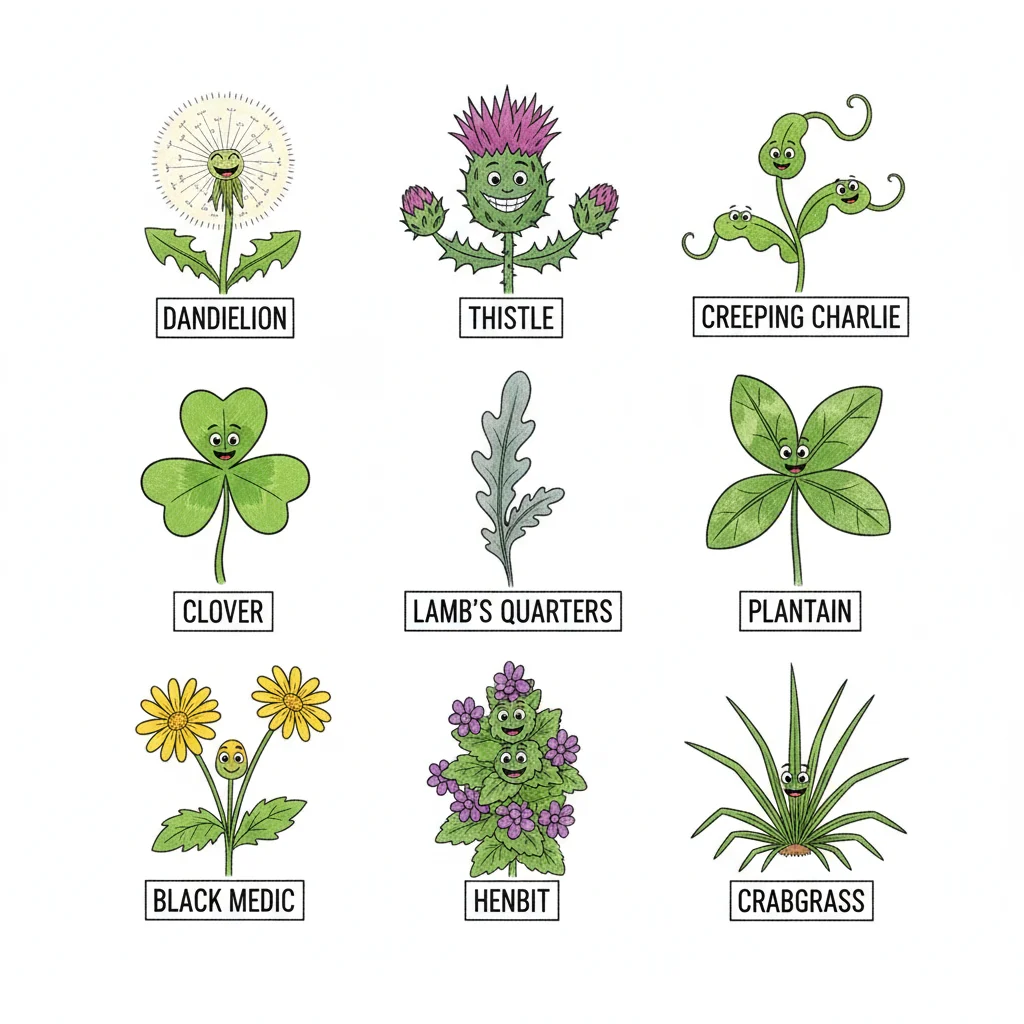
The most common lawn weed names you will hear are Dandelion, Crabgrass, Clover, Plantain, and Creeping Charlie (Ground Ivy). These are found in yards all over the world.
2. Why do weeds have such strange and funny names?
Weeds often get funny names like “Sticky Willy” or “Fat Hen” from old folk traditions. People named them based on what they looked like, what animals ate them, or how they felt to touch.
3. Are there any weed names that are also used for babies?
Yes! Many weed and herb names are popular for babies. Examples include Clover, Daisy, Ivy, Heather, Sage, and Rowan. These are considered nature names.
4. What is the most poisonous weed name I should know?
The most famous poisonous weed name is “Deadly Nightshade” (Belladonna). Others include Hemlock (which killed Socrates) and Wolfsbane. Always be careful handling unknown plants.
5. Where can I find more unique types of weeds with names for a story?
You can find unique names in old herbals (plant medicine books), wildflower guides, or by looking up the Latin names of common weeds like Galium aparine (Sticky Willy) or Chelidonium majus (Celandine).