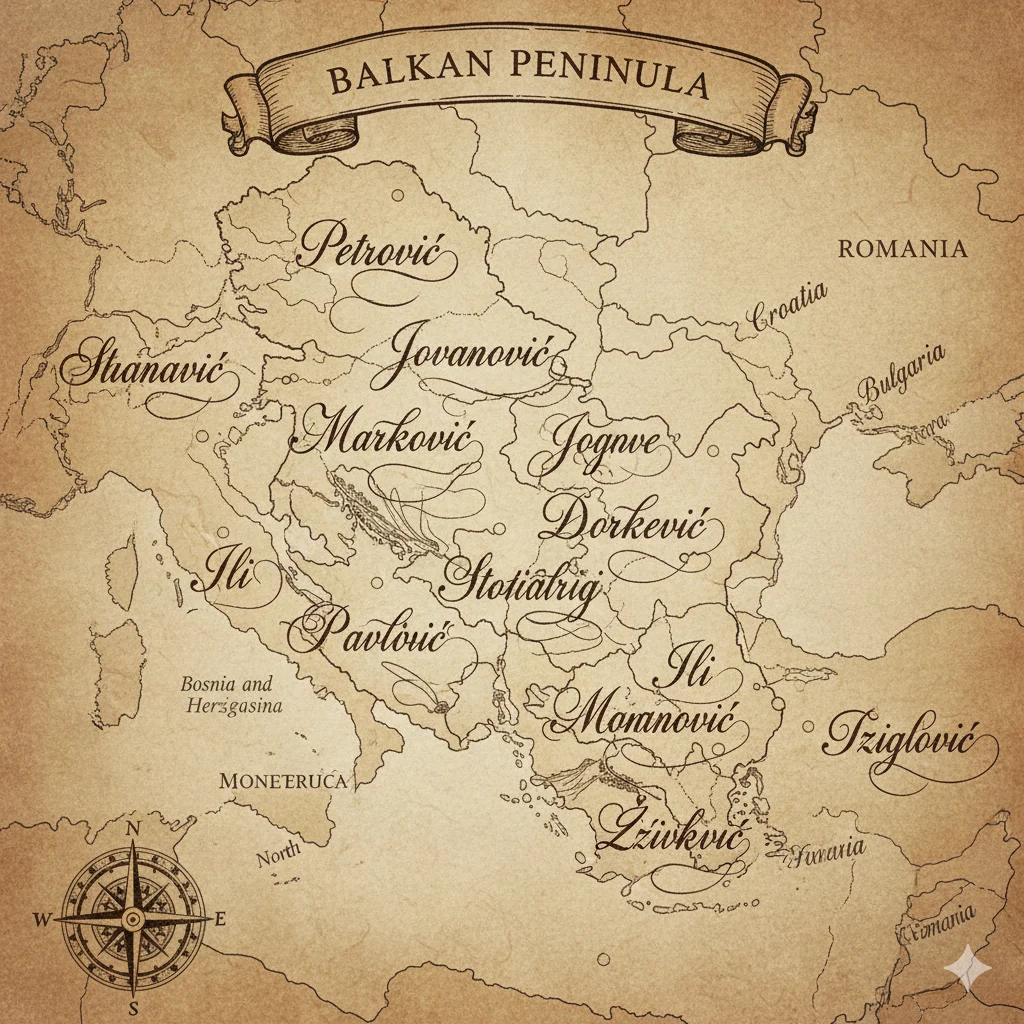
Serbian last names are family identifiers that often end with “-ić” and tell a story about ancestry, like “son of” a father, a person’s job, or a physical trait. They are a key part of Serbian identity and heritage. If you’ve ever wondered about the meaning of names like Petrović or Marković, you’re curious about a deep cultural tradition.
Serbian last names are more than just labels. They are a living record of family history, work, and character. Most are easy to spot because they often end with the letters “-ić.” This little ending is like saying “son of” or “descendant of.” So, Petrović means “son of Petar,” connecting a person directly to their father and ancestors.
Understanding these Serbian surnames helps us see into Serbia’s past. They show old jobs, like Kovač (blacksmith), or family nicknames, like Belić (white-haired). For anyone exploring their roots, creating a character for a story, or just loving names, learning about last names from Serbia opens a door to a rich and proud culture. Let’s explore the different types and their amazing stories.
Patronymic Last Names (The “-ić” Names)
These are the most classic Serbian family names. The “-ić” suffix is a diminutive that came to mean “son of” or “descendant of.” It’s the core of Serbian naming.
Petrović (pe-TRO-vich)
Meaning: Son of Petar (Peter). Origin: Patronymic. Vibe: Classic, strong, foundational.
Best for: A reliable, traditional character or a person with deep family roots.
Jovanović (yo-VA-no-vich)
Meaning: Son of Jovan (John). Origin: Patronymic. Vibe: Very common, historic, everyman.
Best for: A character who is empathetic and well-connected in their community.
Nikolić (ni-KO-lich)
Meaning: Son of Nikola (Nicholas). Origin: Patronymic. Vibe: Steady, friendly, approachable.
Best for: A wise helper figure or a skilled craftsman.
Marković (mar-KO-vich)
Meaning: Son of Marko (Mark). Origin: Patronymic. Vibe: Energetic, adventurous.
Best for: An explorer, a leader, or someone with a bold spirit.
Đorđević (JOR-je-vich)
Meaning: Son of Đorđe (George). Origin: Patronymic. Vibe: Resilient, farmer-strong.
Best for: A grounded, hardworking person tied to the land.
Last Names Based on Occupations
Many traditional Serbian surnames come from the jobs people did centuries ago. They tell us about the medieval economy and social structure.
Kovačević (ko-VA-che-vich)
Meaning: Son of the blacksmith (Kovač). Origin: Occupational. Vibe: Strong, creative, foundational.
Best for: A builder, a strong protector, or someone who “forges” their own path.
Popović (PO-po-vich)
Meaning: Son of the priest (Pop). Origin: Occupational/Patronymic. Vibe: Scholarly, spiritual, respected.
Best for: A teacher, a counselor, or a character with a moral center.
Mladenović (mla-DE-no-vich)
Meaning: Related to a young man or servant (Mladen). Origin: Occupational. Vibe: Youthful, service-oriented.
Best for: A loyal companion or an ambitious young apprentice.
Radić (RA-dich)
Meaning: Derived from “rad” meaning work; the worker. Origin: Occupational. Vibe: Diligent, humble, hardworking.
Best for: The dependable, quiet hero who gets things done.
Pejčinović (pey-CHEE-no-vich)
Meaning: Son of the herdsman (related to “pečalba”). Origin: Occupational. Vibe: Wanderer, caretaker.
Best for: A traveler, a guardian of animals, or someone with a nomadic past.
Last Names from Physical Traits or Nicknames
These common Serbian surnames started as descriptive nicknames for a person’s look or personality, which then got passed down.
Belić (BE-lich)
Meaning: Derived from “beo” meaning white; the white-haired or fair one. Origin: Descriptive. Vibe: Distinctive, noticeable, wise.
Best for: An elder, someone with a striking appearance, or a calm leader.
Stanković (stan-KO-vich)
Meaning: Son of Stanko (from “stati” – to stand, or “stan” – camp). Origin: Descriptive/Patronymic. Vibe: Resilient, steadfast.
Best for: A stubborn survivor or a loyal guardian.
Babić (BA-bich)
Meaning: Could mean “son of an old woman” (baba) or related to a grandmother. Origin: Descriptive/Family. Vibe: Nurturing, perhaps wise or quirky.
Best for: A caring matriarch/patriarch or a character with deep folk wisdom.
Crnički (CR-neech-kee)
Meaning: From “crn” meaning black; the dark or black-haired one. Origin: Descriptive. Vibe: Mysterious, strong-willed.
Best for: A character with a dark past, intense passion, or hidden depth.
Debeljak (DE-be-lyak)
Meaning: The stout or robust one. Origin: Descriptive. Vibe: Strong, solid, hearty.
Best for: A physically strong character, a jovial friend, or a resilient fighter.
67+Japanese Flower Names & The Tiny Detail You Got Wrong ❌
Last Names from Animals
Nature and animals were big influences. These Serbian surnames might relate to a family’s hero, trade, or a personal characteristic.
Vuković (voo-KO-vich)
Meaning: Son of Vuk (wolf). Origin: Animal/Patronymic. Vibe: Fierce, loyal, protective.
Best for: A fierce warrior, a lone wolf who protects their pack, or a strategic leader.
Lukić (LOO-kich)
Meaning: Could be from “luk” (onion/bow for shooting) or “lukan” (a type of fish). Origin: Varied. Vibe: Sharp, layered, or adaptable.
Best for: A skilled archer, a complex personality, or someone who thrives in different environments.
Gavrilović (gav-ri-LO-vich)
Meaning: Son of Gavrilo (Gabriel). Origin: Religious/Patronymic. Vibe: Strong, archangel-like.
Best for: A messenger, a protector with strong principles, or a visionary.
Paunović (pa-OO-no-vich)
Meaning: Son of Paun (peacock). Origin: Animal/Patronymic. Vibe: Proud, beautiful, showy.
Best for: An artist, a performer, or someone with great pride and elegance.
Zec (ZETS)
Meaning: The hare or rabbit. Origin: Animal. Vibe: Quick, clever, agile.
Best for: A fast thinker, a clever trickster, or someone who is always on the move.
Last Names from Places or Geography
These names show where a family originally came from, like a town, a landscape feature, or a region.
Šumadija (shoo-MA-di-ya)
Meaning: From the Šumadija forest region of central Serbia. Origin: Geographical. Vibe: Proud, heartland, natural.
Best for: A character deeply tied to their homeland, nature, and tradition.
Delić (DE-lich)
Meaning: Could be from “delija” meaning hero, or a place name. Origin: Geographical/Descriptive. Vibe: Brave, heroic.
Best for: A brave warrior or a charismatic hero figure.
Prekodolac (pre-ko-DO-lats)
Meaning: Someone from “across the valley.” Origin: Geographical. Vibe: Journeyer, from another place.
Best for: An outsider, a traveler, or someone with a perspective from afar.
Planinić (pla-NEE-nich)
Meaning: From the mountains (planina). Origin: Geographical. Vibe: Strong, resilient, lofty.
Best for: A solitary figure, a resilient survivor, or someone with high ideals.
Beogradski (be-o-GRAD-skee)
Meaning: From the city of Belgrade (Beograd). Origin: Geographical. Vibe: Urban, cosmopolitan, historic.
Best for: A politician, a historian, or a sophisticated city-dweller.
Unique and Rare Serbian Surnames
These unique Serbian last names are less common and often have very specific, interesting origins.
Nemanjić (ne-MA-nyich)
Meaning: The most famous Serbian medieval dynasty. Origin: Historical Dynasty. Vibe: Royal, powerful, legendary.
Best for: A royal character, a leader of great legacy, or in historical fiction.
Obilić (o-BEE-lich)
Meaning: Famous from the epic hero Miloš Obilić. Origin: Historical/Descriptive. Vibe: Heroic, legendary, brave.
Best for: The ultimate hero or martyr figure in a story.
Kosovac (KO-so-vats)
Meaning: Person from Kosovo (Kosovo). Origin: Geographical. Vibe: Deeply historical, poignant.
Best for: A character tied to Serbian history, identity, and memory.
Smiljanić (smi-LYA-nich)
Meaning: Possibly from “smilje” (a flower, immortelle) or a personal name. Origin: Nature/Patronymic. Vibe: Delicate, enduring, beautiful.
Best for: A kind, enduring character with inner strength.
Vidaković (vi-DA-ko-vich)
Meaning: Son of Vidak (possibly related to sight or Vidovdan). Origin: Patronymic/Historical. Vibe: Perceptive, visionary.
Best for: A seer, a strategic thinker, or a spiritually aware person.
Last Names with Religious Meanings
Faith has always been central, and many Serbian surnames reflect Christian Orthodox beliefs.
Bogdanović (bog-DA-no-vich)
Meaning: Son of Bogdan (God-given). Origin: Religious/Patronymic. Vibe: Blessed, fortunate, gracious.
Best for: A kind-hearted, fortunate character, or a “chosen one” archetype.
Svetislavić (sve-TEE-sla-vich)
Meaning: Related to “svet” (holy, light) and “slava” (glory). Origin: Religious. Vibe: Glorious, pure, luminous.
Best for: A pure-hearted hero or a character destined for greatness.
Dabić (DA-bich)
Meaning: Possibly from “daba” (an old word) or a shortened form. Origin: Varied. Vibe: Simple, grounded.
Best for: An everyday person with a simple, honest life.
Mirosavljević (mi-ro-SAV-lye-vich)
Meaning: Son of Miroslav (peace and glory). Origin: Religious/Patronymic. Vibe: Peaceful, dignified, respected.
Best for: A peacemaker, a diplomat, or a noble leader.
Hristić (HRI-stich)
Meaning: Son of Hrista (Christ). Origin: Religious/Patronymic. Vibe: Pious, devoted, symbolic.
Best for: A deeply religious character or a symbolic “everyman” figure.
71+Cute Penguin Names: The Untold Story Will Melt Your Heart 🐧💖
Funny or Unusual Serbian Surnames
Some names sound funny or strange to modern ears, often from old words or blunt descriptions.
Pantić (PAN-tich)
Meaning: Could be from “panta” (a rag) or a nickname. Origin: Descriptive. Vibe: Quirky, humble.
Best for: A comic relief character or someone who is unpretentious.
Smrdonja (SMR-don-ya)
Meaning: The smelly one. Origin: Descriptive (humorous/insulting). Vibe: Comically unpleasant.
Best for: A villainous henchman, a gross character, or in pure comedy.
Brzak (BRZ-ak)
Meaning: The fast one. Origin: Descriptive. Vibe: Speedy, impulsive.
Best for: A messenger, a hyperactive child, or a speedy athlete.
Gluvak (GLOO-vak)
Meaning: The deaf one. Origin: Descriptive. Vibe: Possibly stubborn or isolated.
Best for: A character who is stubborn or who misunderstands situations.
Lojen (LO-yen)
Meaning: The greasy or oily one. Origin: Descriptive. Vibe: Slippery, untrustworthy.
Best for: a sneaky merchant, a dishonest character.
Modern and Simplified Serbian Last Names
In modern times, some families, especially abroad, may shorten or adapt their names.
Ilić (I-lich)
Meaning: Son of Ilija (Elijah). Origin: Patronymic (shortened). Vibe: Modern, simple, strong.
Best for: A contemporary character with Serbian heritage.
Savić (SA-vich)
Meaning: Son of Sava (Saint Sava). Origin: Religious/Patronymic. Vibe: Wise, spiritual, clean.
Best for: A modern intellectual or a character on a personal journey.
Anđelković (AN-jel-ko-vich)
Meaning: Son of Anđelko (little angel). Origin: Religious/Patronymic. Vibe: Kind, protective, good.
Best for: A gentle guardian or a character with a pure soul.
Stojanović (sto-YA-no-vich)
Meaning: Son of Stojan (one who stands). Origin: Descriptive/Patronymic. Vibe: Resilient, modern classic.
Best for: A steadfast friend or a reliable professional in a modern story.
Lazić (LA-zich)
Meaning: Son of Laza (short for Lazar). Origin: Patronymic. Vibe: Friendly, approachable, common.
Best for: The friendly neighbor or colleague in any setting.
The Importance of Family “Slava”
A unique tradition tied to Serbian last names is the “Slava” or Patron Saint’s Day. It’s a celebration of the family’s conversion to Christianity centuries ago. Each family has a specific saint they celebrate with a feast. The Slava is often passed down from father to son, meaning the saint is linked to the Serbian family name. This makes the surname not just a name, but a key to a family’s spiritual identity and its most important annual celebration.
Conclusion
Serbian last names are like a hidden language, telling stories of fathers and sons, blacksmiths and priests, wolves and mountains. From the common Petrović to the royal Nemanjić, each one carries a piece of history and identity. Whether you are researching your own Serbian surnames, writing a story, or simply curious, these names offer a fascinating look into a culture that values family, history, and resilience. The next time you see a name ending in “-ić,” you’ll know it’s more than just a name—it’s a story waiting to be read.
FAQs About Serbian Last Names
What is the most common Serbian last name?
The most common Serbian last name is Jovanović, meaning “son of Jovan (John).” Other very common names include Petrović, Nikolić, and Marković.
Why do so many Serbian last names end in “-ić”?
The “-ić” suffix is a patronymic ending that essentially means “son of” or “descendant of.” It’s the most distinctive feature of Serbian surnames and shows family lineage, like Johnson in English.
How are Serbian last names formed for women?
Traditionally, women add the suffix “-a” to their father’s or husband’s surname. For example, the daughter or wife of a man with the last name Petrović would use the last name Petrovića. However, in modern usage, especially abroad, many women use the base form (Petrović) without change.
What does the “Slava” have to do with my last name?
The Slava (family’s patron saint celebration) is inherited patrilineally, meaning it is tied to the male lineage and, therefore, the family’s last name. Your surname can often be a clue to which saint your family celebrates.
Can a Serbian last name tell me where my family is from?
Sometimes! Surnames like Šumadija, Kosovac, or Beogradski directly reference regions or cities. Others, derived from occupations or nicknames, are more about what your ancestors did or looked like rather than a specific location.
Are there any royal Serbian last names?
Yes, the most famous is Nemanjić, the name of the medieval dynasty that ruled Serbia for over 200 years and created the Serbian Orthodox Church. It is a surname of great historical importance.
How do I pronounce “Đ” and “Č” in Serbian names?
- Đ / đ is pronounced like the “j” in “jam” (e.g., Đorđević is “JOR-je-vich”).
- Č / č is pronounced like the “ch” in “chair” (e.g., Čosić is “CHO-sich”).
What if my last name doesn’t end in “-ić”?
Not all do! Many Serbian surnames are based on occupations (Kovač = blacksmith), characteristics (Belić = white), or places without the “-ić” suffix. These are often older or from specific regions.
Do Serbian last names have meanings?
Almost always! Whether it’s “son of,” “blacksmith,” “wolf,” or “white,” Serbian surnames are descriptive and almost every one has a specific meaning and origin story.
How can I find out the meaning of my specific Serbian last name?
Start by looking for the root word (the part before “-ić”). Research that root in Serbian (e.g., “vuk” = wolf, “kovati” = to forge). Consulting with family elders, Serbian cultural societies, or specialized onomastic (name study) resources can also help.